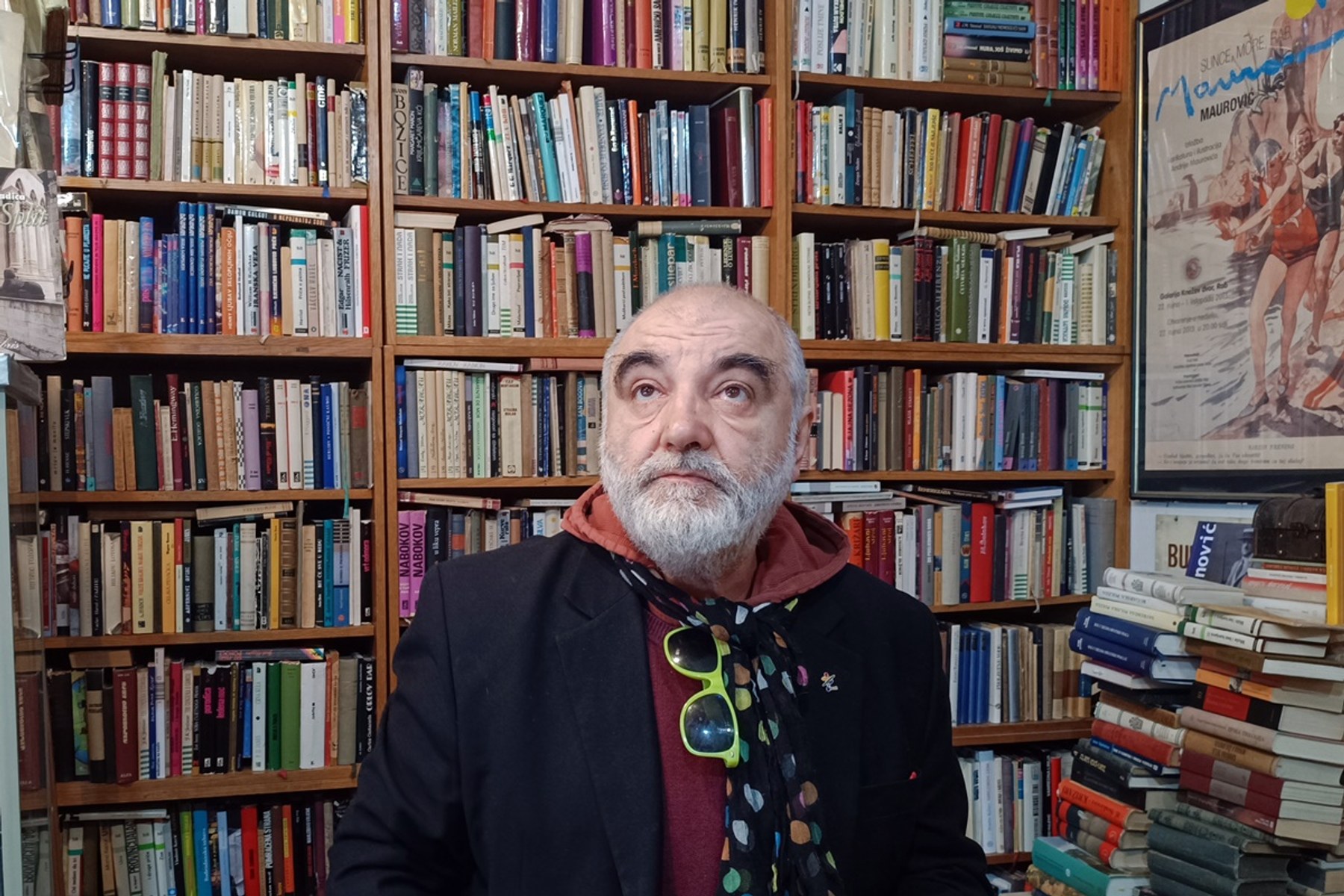
The mere mention of Jusuf Hadžifejzović speaks for itself; a man who needs no special introduction in the art world, he recently stopped in Rijeka while traveling to Sarajevo. One of the most prominent, if not the most prominent, conceptual artists from the "hilly Balkans," he arrived in Rijeka from Venice, where he recorded yet another of his numerous Venetian performances.
When the Revizor Foundation awarded Jusuf Hadžifejzović a scholarship a few years ago as symbolic support for his dedication to art and continuous efforts in nurturing cultural pluralism, their statement read: “As an artist, Jusuf Hadžifejzović confronts current themes from his immediate environment, such as the social and economic voids emerging from the collapse of the former system, the war of the 90s, and economic changes in the context of failed privatization. Hadžifejzović has managed to unify several different practices of action, thereby filling the vacant spaces where the system failed. The best example is his long-standing intervention in a business space within the Skenderija shopping center and the founding of the Charlama Depot gallery as an experimental yet engaged practice of resistance against the post-war political establishment.” This concise summary faithfully outlines Hadžifejzović’s life—or rather, his way of life. For him, art is exactly that: both life and a way of living.
Since he arrived in Rijeka from Venice, it was only logical to begin the conversation with this giant of the scene—and the Bosnian artist with the highest number of recorded appearances in Venice—with a brief reflection on the Biennale. This year, he participated there as part of the "Nomadic Party" project, which aims to demonstrate the creative possibilities that connect man and nature, art and the environment.
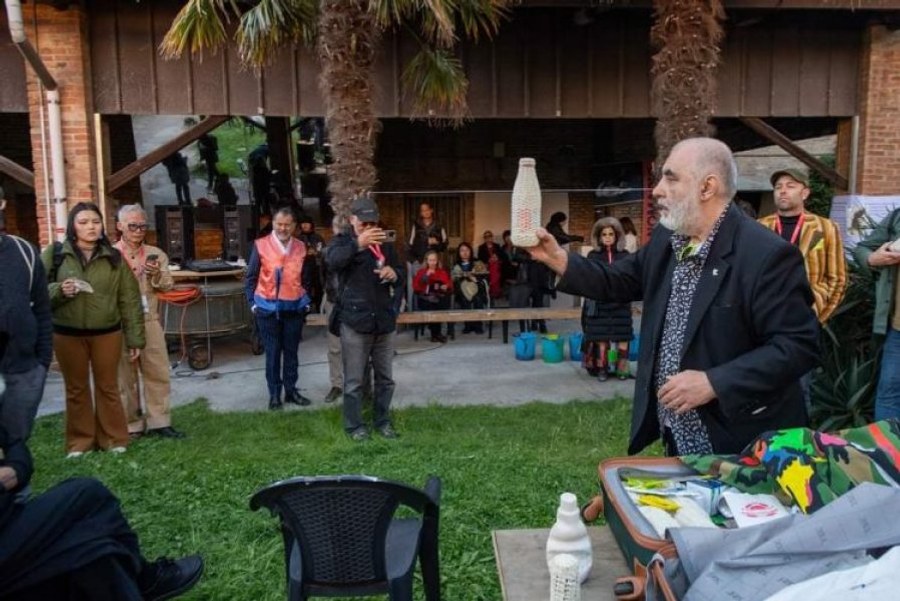
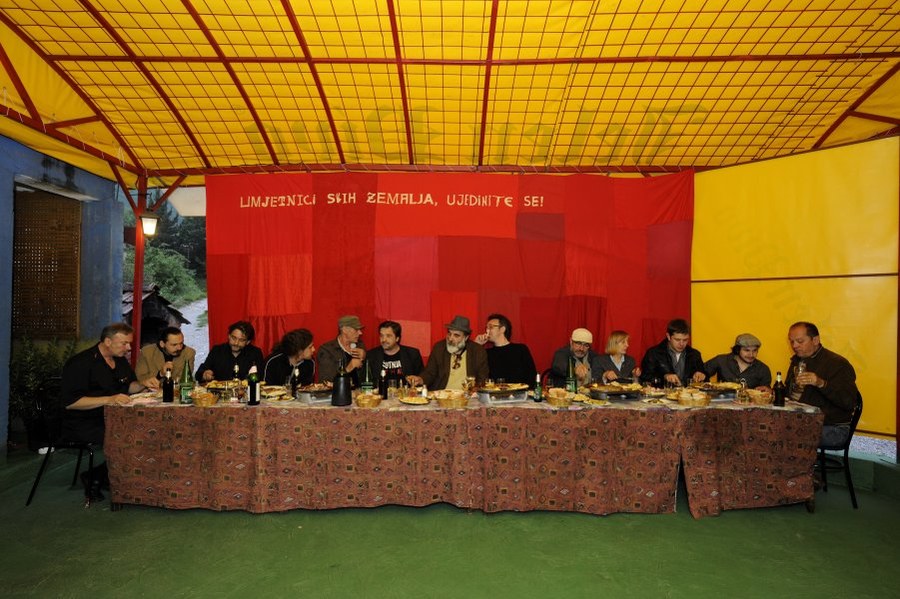
Nomadic Party is a project by the artistic association Nine Dragon Heads, led by Park Byoung-uk from South Korea. The project runs parallel to the Venice Biennale, featuring 40 international artists. At the opening of the Nomadic Party exhibition, I performed a piece titled ‘Showing New Emptiness’ (Pokazivanje novih praznina); I brought some of the materials for it from Sarajevo, while others I collected on the way to Venice. Jasmin Duraković screened his documentary film ‘The Last YU Documenta’. I saw very little of the Biennale itself; there simply wasn't enough time. The Venice Biennale is the world’s largest Art Fair. Great powers demonstrate their might by investing massive capital into the production of artworks, while impoverished nations don’t care for a more serious presentation of their artists.”
You visited Venice with the “Demonstration of Objects in the Shop of Emptiness”; in recent years, you’ve been concentrated on "emptiness"?
“Even though I worked on establishing my art earlier—because the faster it establishes itself, the faster it moves forward—I introduced money into the whole story. I’ve done it before because I care about as many people as possible owning my work, which was an idea of Joseph Beuys. He created multiples for poor students so everyone could afford his work; he had the idea of working for galleries and wealthy collectors on one hand, but also for those who couldn't financially afford such a piece at that level. What happened then? Giacinto di Pietrantonio wanted to contrast two artists, one from Europe and one from America, for an exhibition near Milan titled After the War. He had Andy Warhol...with a silk-screen print of James Dean, and Joseph Beuys with a silk-screen titled We Are the Revolution. And what happened? He found too many of Warhol's prints, but only two by Beuys. My assumption is that this happened because Beuys' work cost 100 German Marks, so everyone bought it. But when a student buys such an inexpensive work, they roll it up, misplace it, move house, and the work doesn't survive. Beuys sold his work cheaply, so money couldn't begin to act as a preservative. When you pay a lot for a work, you take better care of it. That is my assumption. Otherwise, the production of that work was handled by the famous gallery owner from Naples, the renowned Lucio Amelio."
The "emptiness" could be interpreted in many ways, but it is a definitive fact that you have given discarded objects a new life. But what is "emptiness" to you?
"Lao Tzu, the famous Chinese philosopher, had a theory—when I exhibited the work Antimilitaristische Kunst Malerei in South Korea, I wrote that it was a homage to Lao Tzu. Lao had a theory about the moment when one thing transforms into another. In my work, for example, that is when an empty pack of cigarettes, which should be thrown away, transforms into a work of art. At the beginning, I sold them at the price the pack had while it was full; I sold them in galleries and on the street for so little money that anyone who thought it was art could afford it. I decided on this step because I realized it was high time that art trade began in Bosnia and across the entire Balkans in order to preserve it. That is 'money as a preservative.' A collector once bought a valuable work in a gallery and received another valuable one as a gift. When asked which work he would save in the event of a fire, he said: 'The one I bought!' And that’s it."
"The famous philosopher Maimonides, who was later exiled from Spain, stated that 'Where there is emptiness, there is no God!' I knew nothing about emptiness then; I learned everything later. When I exhibited in Novi Sad during the 60th anniversary of BITEF, and all participants made small 'statements,' Peter Brook once stated that 'Everything begins and ends in emptiness!' And who am I to act clever? I took that, wrote it down, and signed Peter Brook's name. That covers everything."
Actually, I had been working on 'emptiness' without even realizing I was doing it. When I returned to Sarajevo from Antwerp, everything had changed—except for that Radion detergent packaging. It remained exactly the same. So, I started collecting them like crazy. There was also a milk brand called 'Dobro jutro' (Good Morning); I found that charming too. I began stacking them on a shelf a carpenter made for me. Later, I wanted to put together packages for people in Belgium who had supported critics and artists remaining in Sarajevo during the war. I packed those empty containers—those voids—into crates measuring one meter by one meter. I liked them so much in the end that I never sent them to anyone."
You were born in Prijepolje, finished art school in Sarajevo, studied in Belgrade and Düsseldorf, lived in Antwerp, and have exhibited all over the world. How much have all these experiences shaped you as an artist?
"For the exhibition in Venice, I created a new biography that includes over a hundred cities where I have exhibited. No gallery names, just cities. I included cities from the very beginning of my career, from the early days—Prijepolje, Priboj, Nova Varoš—small places that barely have a local cultural center. It was never important to me how large the city was or how famous the venue; the only thing that mattered was that people saw contemporary art. Now, it so happened that I sent about ten photos for the catalog, and one photo from Prijepolje, where I was selling 'emptiness,' was included. To me, that is a very moving photograph. I can't say that all those cities influenced my work, but they certainly influenced my life. Especially when one exhibits a lot and doesn't only choose prestigious venues and famous galleries—even though there were many exhibitions in such renowned spaces, like the Tretyakov Gallery and many others."
Cathartic, provocative, prophetic. This is how art historians mostly look back on Jusuf Hadžifejzović’s performances today, and some of them truly belong in the anthology of contemporary art. Such is the case with the one titled "From Kitsch to Blood is Only One Step," created on the eve of all those bloody events of the 1990s, or "Fear of Drinking Water," performed in Cetinje in 1994. In that instance, practically on hostile territory while the war was still in full swing, he gathered his entire family and met with them for the first time in years. It must have taken immense courage to utilize one's family in that way and place them within the function of an artwork?
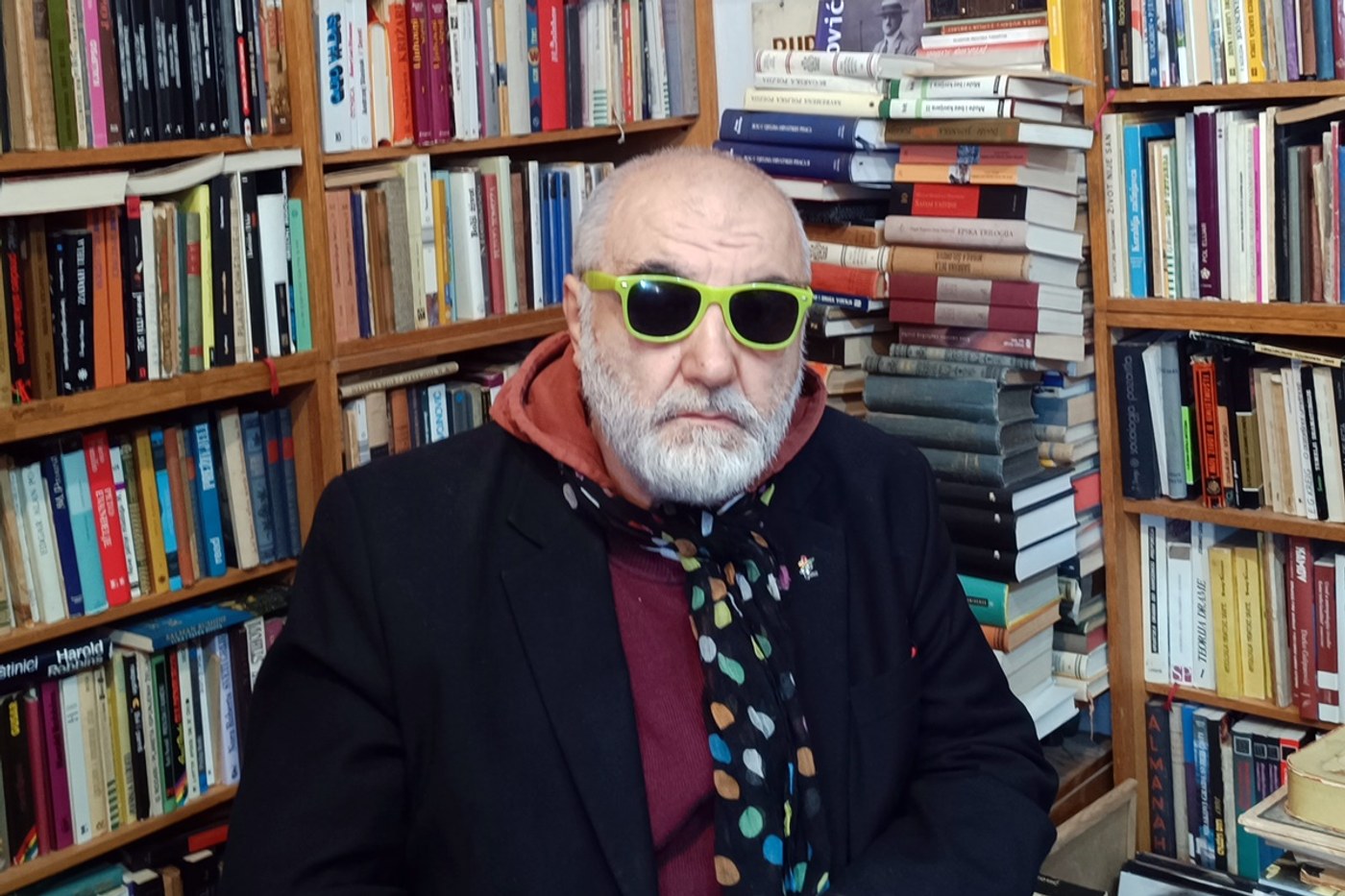
I brought my entire family to Cetinje, and since I was already settled there, I said that nothing would make sense if I were to meet them before the performance itself; if I saw them beforehand, I said I wouldn't repeat it. I wanted to capture that moment of our first meeting after three and a half years during the opening of the Cetinje Biennale. The war was still going on; I came to Cetinje from Belgium by flying to Albania, and Prince Nikola, who organized the biennale, came to the border between Albania and Montenegro and arranged for me to cross without being checked by the army of that time. I must admit, I was afraid. The war was still in progress, and I was only interested in a minimum level of security. And they handled that well. I heard from some old artists, "pick the flowers around you." I liked that very much. I often applied that maxim to my works—I created art from what was closest to me, which in this case was my family. When they invited me to the biennale, while I was living in Belgium, I said I definitely wouldn't go; I was afraid of being detained, interrogated... I named the performance "Fear of Drinking Water" because long before that, my friends Ilija Pavinčević and Petar Čurković had taken me to Ivanova Korita on Lovćen, and that water was cold and very delicious. Later, I was traveling from Antwerp to Berlin, where I had an exhibition at the Kunst Voelker Gallery—which is very famous today and exhibits American minimalists—I bought a bottle of water that was in a plastic blue bottle, and because of the color of that bottle, it looked surreally natural. It was then that I remembered Ivanova Korita, and that quite poetic title came to mind. I always care about titles, but never before or since has any of my work had such a poetic name. When the opening of the biennale took place in the courtyard of the former French embassy, a lot of people gathered, mostly from Serbia and Montenegro, and someone told me that most of them were crying. It was an incredibly moving moment, and not just for me. That was the first time I picked up my brother's daughter; I lift her up, and she asks me: "Uncle, what is your name?". She had never had the chance to see me. When I remember that, a tear comes to my eye on its own.
Cetinje is connected to Rijeka in a strange way; in fact, you yourself stated that you have performed the most in Cetinje and Rijeka. Where does such a strong connection with Rijeka come from?
It is true that I have performed the most in Rijeka and Cetinje. It just happened to work out that way. Actually, Sven Stilinović brought me to Rijeka and introduced me to Damir Čargonja "Čarli." However, I had exhibited in the Modern Gallery even earlier, back when Branko Cerovac was the curator. At that time, I did a performance titled "Preparing the Artist for the Opening of the Exhibition" and created a work called "Long Live Arte Povera." The director then was Ljubica Dujmović, and she bought one of my works that had been exhibited at the Yugoslav Youth Biennale a long time ago. They wanted to give me an award for that piece at the biennale, but Boris Vižintin protested, saying that the objects the work was composed of were museum property. So, I didn't get the award.
You are also linked to Rijeka through your participation in the project "Goli Otok – New Croatian Tourism"?
– I was on Goli Otok two, maybe three times. I opened a café there called the Goli Otok Caffe Depot. I sold six liters of Istrian honey brandy (medica) at the time, which was a way to highlight the connection to tourism. Goli Otok could have been a world-class art destination. I said as much back then. I believed that one pavilion should be given to all the former prisoners—that is, to artists from all those former republics—to create an exhibition there every year. When I saw the state of the remaining buildings, I realized that Goli Otok is "naked-er" today than ever before. Goli Otok could have been an art colony that provided the world with a top-tier visual arts event every year. That would have been the smartest and fairest thing; the whole world would have come to see it.
– It is difficult with today’s politicians; they think that first came they, and then everyone else. If there is money in it for them, they will take action. If there is no money, there is no action. Unfortunately, we do not have politicians who love art from the heart, as is the case in Germany, for example. My professor Klaus Rinke was an extra at the opera in Paris; one day he received a call from the Minister of Culture to come and teach at the academy in Düsseldorf. You know how simple it is—you take an artist's catalog and see who has done something clever. You don't need anything else. But it doesn’t work like that in this region.
The Rijeka work "Long Live Arte Povera," as well as many other exceptionally successful works—such as the Roman "cloning" of Mussolini, where a small Mussolini emerged from the head of a large Mussolini, which greatly stirred the Italian scene—were created from what you found at the location where you arrived. Is that the "depography" of Jusuf Hadžifejzović?
– Ugo Vlaisavljević invented that term, depography. Vlaisavljević has, in fact, written several texts about my work; the first one he wrote was incredible, and he had never even met me in his life at that point. He wrote it based on a few works he had seen. Depography. I never had a studio; I adapted my way of life to my works. I would arrive at the place I was invited to with my hands in my pockets, and I would create a work from whatever I found there. While I was doing depographies, I felt like a magician. Sometimes I would come across things that were so unbelievable I started fantasizing that it was the hand of God that made it, because I certainly wasn't capable of it. I can't react until I see. But when I see those things, everything immediately falls into place. That is depography.
Isn’t "depography" a kind of nomadic art—a man with his hands in his pockets moving from city to city, leaving art behind him?
– It couldn't be more nomadic. But now it's different. In America, I sold "American emptiness"; when I was in Canada, I sold "emptiness from the plane." When I arrive in a city, I buy something to eat and immediately I have new voids. It all depends on your pedigree and who wrote about you in the city you’re visiting. Once, a woman came to Charlama who was writing her doctoral dissertation either on me or on contemporary art, but after her, all her professors came to the gallery. And they bought up the "emptiness" because she had inaugurated it.
The Charlama Depot Gallery, which you founded in the Skenderija center, recently faced major problems; you were barred from the space where practically everything you’ve worked on and everything you’ve collected over the years is stored. How did you experience those events?
– All the smart people who came to Charlama said that it somehow must be preserved. I would be happy if, during my lifetime, I could leave it to Sarajevo or any city that would know how to appreciate it. It pains me deeply that Sarajevo lacks a structure of politicians and art historians who would consciously stand behind the preservation of this legacy. Quite the opposite—they’ve closed the gallery and cut the lights two or three times already. That speaks volumes about how much they understand what I’ve spent my whole life doing. As far as I’m concerned, I won't be trying anymore. I believe I’ll find a city that has the understanding to let it survive. I don’t know how it will function in Sarajevo; we’re doing SubDokumenta again, so we’ll see how it all unfolds. Once, as a young artist, I was at an art colony where Zuko Džumhur was invited. I was on the artistic council of that colony, but the nationalists in power kicked me out. All the local politicians from Prijepolje came and rented a hall, and Đorđe Kadijević, a well-known critic for NIN, asked Zuko Džumhur: "What is the difference between our God and yours?" Zuko replied: "Almost none, except ours is a bit smarter!" And Đorđe lost his mind. My point is, I understand that politicians love themselves, but I don't understand how they can love art so little. At a biennale, I once saw a market tote bag with the inscription "In Art we trust," while the dollar says "In God we trust." This "In Art" version certainly wouldn't fly in Sarajevo, but if it said "In God and Art we trust," it would surely be a success. All the religions would attack me. And when they attack you, then you have a breakthrough.
Does it sadden you that Sarajevo—the city where in 1984, with Radoslav Tadić and Aleksandar Saša Bukvić, you launched YU Documenta, the largest exhibition of contemporary art in the former state—has such a relationship toward Charlama and your work? Why is that?
– It’s because in Sarajevo, forgetfulness reigns. When people write about the Sarajevo Film Festival, or this or that, no one ever mentions YU Documenta. A critic from Zagreb once chose the three most significant exhibitions in the history of the former state, and YU Documenta was one of them. Where there is no sense, it’s hard to rely on coincidence. But I can't change that; I can only be sad about it. That’s why I’m glad Jasmin Duraković made the documentary The Last YU Documenta; the main goal was to rescue that incredible, yet today forgotten, exhibition of modern and contemporary art from oblivion. I once asked Goran Milić—former director of Yutel and Al Jazeera, who often frequented the café I went to—to do a report on YU Documenta, and he replied: "Jusuf, who is interested in that?" How can someone be interested when no one knows anything about it? People would have to know it existed first, then maybe someone would get interested. It became clear to me then that Goran Milić was far removed from art.
Were there attempts by the authorities to win you over, to make you a "regime artist" in some way? Perhaps you could have solved the problems with Charlama more easily that way?
– Not a chance. They didn't even let me near the Academy to teach. We were sitting at the Academy once, and Sado Musabegović told the late Ratko Lalić that it would be good to accept Jusuf—to open the windows and let in some "fresh air from the West." Lalić replied: "Sado, you're crazy! He’d kick all of us out of the Academy in three months!" Sado turned to me and asked: "Would you, Jusuf?", and I answered: "Not in three, in two!" They didn't like me. When those professors fled during the war, one of the younger generation professors from Skopje, who first exhibited with me at YU Documenta, said he knew why they didn't want Jusuf at the Academy. Because Jusuf has a better biography than all of them combined. And it's true. They didn't want someone who was capable of creating YU Documenta, because everyone knew that person would work wonders at the Academy. I have nothing against their salaries, but there’s a big difference between a professor who receives a million marks in pay over a lifetime at the Academy and just drinks it away without achieving anything, and someone who would work wonders for ten times less. And I’ve done plenty without a cent—imagine if I’d had the position.
Even though you tried to introduce money into your art, material things were never important to you?
– No. Because I came from a family of traders; we didn't have huge amounts of money, but we traded fruit and vegetables, so food was never an issue. There was always something to eat, and that stayed with me. Material wealth was never important to me. If I’d had a child when I was young, maybe I would think differently, but I didn't, so I stayed as I was. However, that doesn't mean I didn't have an idea about money mixing with art—but for the purpose of preserving the art; that "money as a preservative." I bought many works by young artists and supported them. I always remembered that when I was working, not only were there no buyers, but it never even occurred to anyone to buy anything. Today, when young people work, they do it with the premeditation that they will sell it all.
If you could, would you change anything in your creative work today? Do you regret any missed opportunities, or have you even tried to change at all over these years?
– I haven't tried to change at all. I have always done what I do from the heart; I loved art even before I reached these heights and waters—though I don't like talking about my work and success that way. I came from the provinces to Sarajevo with the desire to paint like my professor Vlado Vojnović. It went so quickly that by the third or fourth year of high school, I had already surpassed him. Then I went to the Belgrade Academy of Fine Arts and found out that the curriculum of the art school in Sarajevo was copied from the Belgrade Academy. I realized it was all the same; that repetition led me to the point where I began to question all my acquired knowledge. I was a very skilled draftsman, among the best in my class; students from higher years would come to look at my work. They all thought I was a good artist, but in reality, I was just a skilled draftsman.
It was then that I realized that in Russian, the word for art means 'experience,' while in English, an 'artist' is like a tightrope walker. This implies that for the Western world, art is about knowing how to do something—a skill—but I believe that skill has nothing to do with art. There are so many skillful people who are terrible artists, and there are people who lack the skill of painting but are phenomenal artists. When you see a work by someone like Kožarić, for example, you realize that the work hits you. I was sitting in a café with Kožarić once and he told me: 'Poverty is promising!' I immediately shot back: 'Koža, I’m going to make t-shirts out of this, do I have your permission?' That is the essence. There are surely wealthy people who are good artists, but poor artists are a miracle. That is a gift from God. 'Poverty is promising!' is a legendary sentence to me; I sold a lot of those shirts. I’ve actually made many t-shirts; I remember one with the inscription 'Beware of household appliances'—and that was long before this Artificial Intelligence stepped onto the scene. I also made shirts saying 'Monkeys learn from mistakes, the English at Oxford.' I had a work titled 'Schöne Grüße auf der Bandite Strasse'; the Germans were thrilled, everyone went crazy for that piece.
I can't say I wouldn't change anything, because that wouldn't be true. I don't regret projects; those that were swirling in my head but I never made, I’ve long forgotten. I’ve even forgotten some that I did make— I’ve done so much that I don't even remember it all anymore. When I was making that list of a hundred cities where I’ve exhibited, I told myself that if a Sarajevo artist had merely visited those cities, they would surely have changed. From Saint Petersburg, Moscow, Paris, and Berlin to New Orleans, Montevideo..."
Has art progressed or regressed today?
"Art is constantly progressing, it’s just that those progressive artists can't take the leading positions. Those spots are occupied by people in the economic race. Business crushes everything. However, there are curators who still feel they must follow the continuity of art's development, and they discover new names. I saw that in Venice just now. There were fantastic artists and fantastic works."
Is your will to create fading, or is it still strongly present?
"If you’re asking if I’m tired—I’m not. However, apart from performances, I haven't made anything for a year. In the summer of 2023, in South Korea, I made the painting Antimilitaristische Kunst Malerei, the fifth one so far, but in the largest format. Antimilitaristische Kunst Malerei is an anti-war work, but I didn't want to link it specifically to Gaza or anything else. I made the first one in Slavonski Brod, the second somewhere in Scandinavia, the third in Sarajevo... I could put together an exhibition if I were a slightly more industrious artist. I am industrious enough to make a new work, but not to multiply it. The work falls into the category of 'repurposed emptiness.' An olive-drab uniform is designed so a soldier isn't noticed in their surroundings, but I use bright colors with the intention that the work stands out at the exhibition. Those are the 'emptinesses.' I take an empty surface and create something. I’ve done 'decorations of emptiness,' 'marking of emptiness,' 'materialization of emptiness,' and now I’m knitting socks or sweaters, so I have the 'clothing of emptiness'... I have an entire range of 'emptinesses' that keep opening up. Every six months, something new comes to mind for me to create.”